Corporate strategy and operating model
Corporate strategy is only valuable when it survives day-to-day reality.
Most organisations don’t struggle to create ideas; they struggle to prioritise, communicate, and execute them consistently.
CGI works at the point where ambition meets execution
As teams grow, markets expand, and operating complexity increases, the distance between “what we want to do” and “what we actually deliver” tends to widen. That gap is expensive. It creates duplicated effort, slow decisions, unclear ownership, and reporting that tells you what happened rather than what needs to happen next.
CGI works at the point where ambition meets execution.
We help translate strategic intent into a practical operating architecture: clear roles, decision rights, governance cadence, and reporting that teams can run without the organisation becoming dependent on a handful of senior people constantly unblocking issues.
The objective is simple: faster execution, fewer surprises, and a leadership team that can steer with confidence because the operating model produces decision-grade information.
A useful global reference point is how strongly leaders now view reinvention as a requirement rather than a choice. In PwC’s Global CEO Survey 2025, 42% of CEOs say they do not believe their company will be viable beyond the next ten years without reinvention.
That is not a “strategy problem”; it is an execution and operating model problem.
Organisations can’t reinvent if decisions are slow, accountability is blurred, and delivery relies on informal heroics rather than repeatable systems.
Figure 1 (in gallery). CEOs concerned about business viability without reinvention (PwC Global CEO Survey 2025)
Download: sandbox:/mnt/data/chart_ceo_viability_reinvention_pwc_2025.png
Reference: https://www.pwc.com/gx/en/news-room/press-releases/2025/pwc-2025-global-ceo-survey.html

Programme delivery as a management system
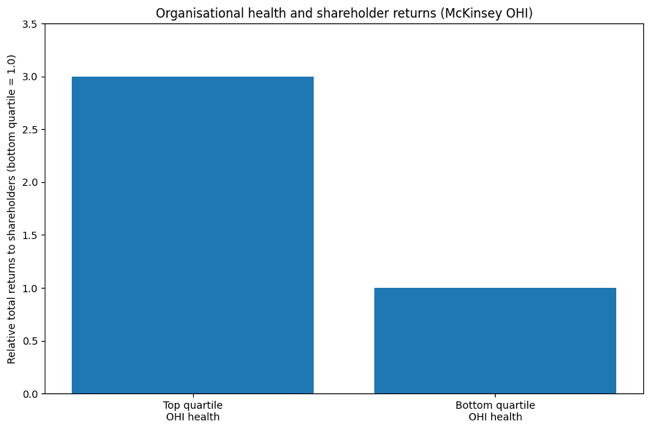
The second global point is that organisational effectiveness is measurable and it correlates with performance.
McKinsey’s work on the Organisational Health Index indicates the top quartile of publicly traded companies deliver roughly three times the returns to shareholders compared with the bottom quartile.
Again, that is not about having a clever strategy statement. It is about how decisions are made, how resources are allocated, how leaders run the place, and whether the operating system turns direction into action.
Figure 2 (in gallery). Organisational health and shareholder returns (McKinsey OHI)
Download: sandbox:/mnt/data/chart_ohi_returns_ratio_mckinsey.png
Reference: https://www.mckinsey.com/capabilities/people-and-organizational-performance/our-insights/organizational-health-a-fast-track-to-performance-improvement
This is where many firms feel the pain.
They have a strategy deck, a set of initiatives, and a management team that is busy, yet progress is uneven.
Priorities compete.
Workstreams overlap.
Decision-making becomes meeting-heavy and slow.
People are unclear on who owns outcomes, so issues drift.
Reporting becomes broad and backward-looking, with limited visibility on what is blocked and why.
In founder-led businesses, this often manifests as “everything comes back to the founder” and the organisation cannot scale without exhausting key individuals.
In larger corporates, it manifests as matrix complexity, hand-offs, and diluted accountability.
A third reference point is the cost of poor execution discipline. PMI’s Pulse of the Profession 2023 reports a global average of 5.2% wasted investment due to poor project performance. In practical terms, that is spend that does not translate into outcomes because delivery is not structured, prioritised, or governed effectively.
Figure 3 (in gallery). Wasted investment due to poor project performance (PMI Pulse of the Profession 2023)
Download: sandbox:/mnt/data/chart_wasted_investment_pmi_pulse_2023.png
Reference: https://www.pmi.org/-/media/pmi/documents/public/pdf/learning/thought-leadership/pmi-pulse-of-the-profession-2023-report.pdf
So what does “corporate strategy and operating model” mean in practice?
It starts with prioritisation that is real, not aspirational.
Many firms try to do too much at once and end up doing very little well.
We help create a clear hierarchy of outcomes, separate “must win” decisions from “nice to have” activity, and define what success looks like in measurable terms.
Where relevant, we establish a simple KPI tree or OKR structure that links day-to-day activity to strategic outcomes, so teams can see the line of sight between effort and impact.
Then we design an operating model that can carry the strategy.
That means clarifying accountability, not just responsibilities.
We map who owns each outcome, who makes which decisions, what can be delegated, and what must be escalated.
We help define decision rights and delegated authorities in a way that increases speed while protecting control.
This is one of the most common shortcomings of larger consultancies: they deliver high-level target operating models that look good on paper but don’t define practical decision boundaries, so leadership still ends up intervening constantly

What's next?
Governance cadence comes next.
Governance is not bureaucracy when it is designed properly; it is the mechanism that converts intention into action.
We establish a meeting rhythm that is built around decisions, exceptions, and actions, supported by a decision log so topics are not endlessly revisited, and an action log so accountability is visible.
The goal is fewer meetings, better meetings, and clearer ownership, with leadership time spent on decisioning rather than chasing updates.
Reporting and management information is then rebuilt so it becomes decision-grade.
Teams do not need more data; they need usable signals.
We focus MI on what changed, what is off-track, what needs a decision, what the risks are, and what the next actions must be.
This is where many organisations feel an immediate uplift: once MI is structured properly, leaders can intervene earlier, projects stop drifting, and teams stop burning time producing packs that don’t drive decisions.
Finally, we translate the operating model into delivery mechanics that stick.
That can include workstream structures, milestone plans, dependency maps, role mapping, quality gates, and a simple tracking cadence.
The operating model is only valuable if it becomes the way the organisation actually works, not a document that lives on a shared drive.

Why CGI, and what clients take away
Clients should be comfortable because the engagement is senior-led and outcomes-first.
You won’t be passed between layers, and you won’t need to repeat your story to multiple teams.
We remain deliberately capacity-controlled so quality does not dilute.
You get practical operating architecture that improves speed and accountability, without introducing unnecessary complexity.
Our focus in one sentence is: turning ambition into measurable outcomes through clear operating architecture and accountable delivery.
The difference between what we do and what we want to be known for is straightforward.
We don’t want to be known for producing documents; we want to be known for leaving organisations clearer, faster, and more controlled than when we arrived.
That means decisions are made quicker, reporting is trusted, responsibilities are explicit, and delivery is measurable.
We are UAE-based but work globally and routinely support cross-border operating models and multi-jurisdiction execution, coordinating specialist support when required while keeping the work coherent and accountable.

Call to action
If you have strategy in motion but execution feels heavy, slow, or inconsistent, book a discovery meeting.
We will confirm the constraints, define the minimum viable operating model changes that unlock pace and control, and present a clear proposal with deliverables, timeline, and measurable outcomes.